
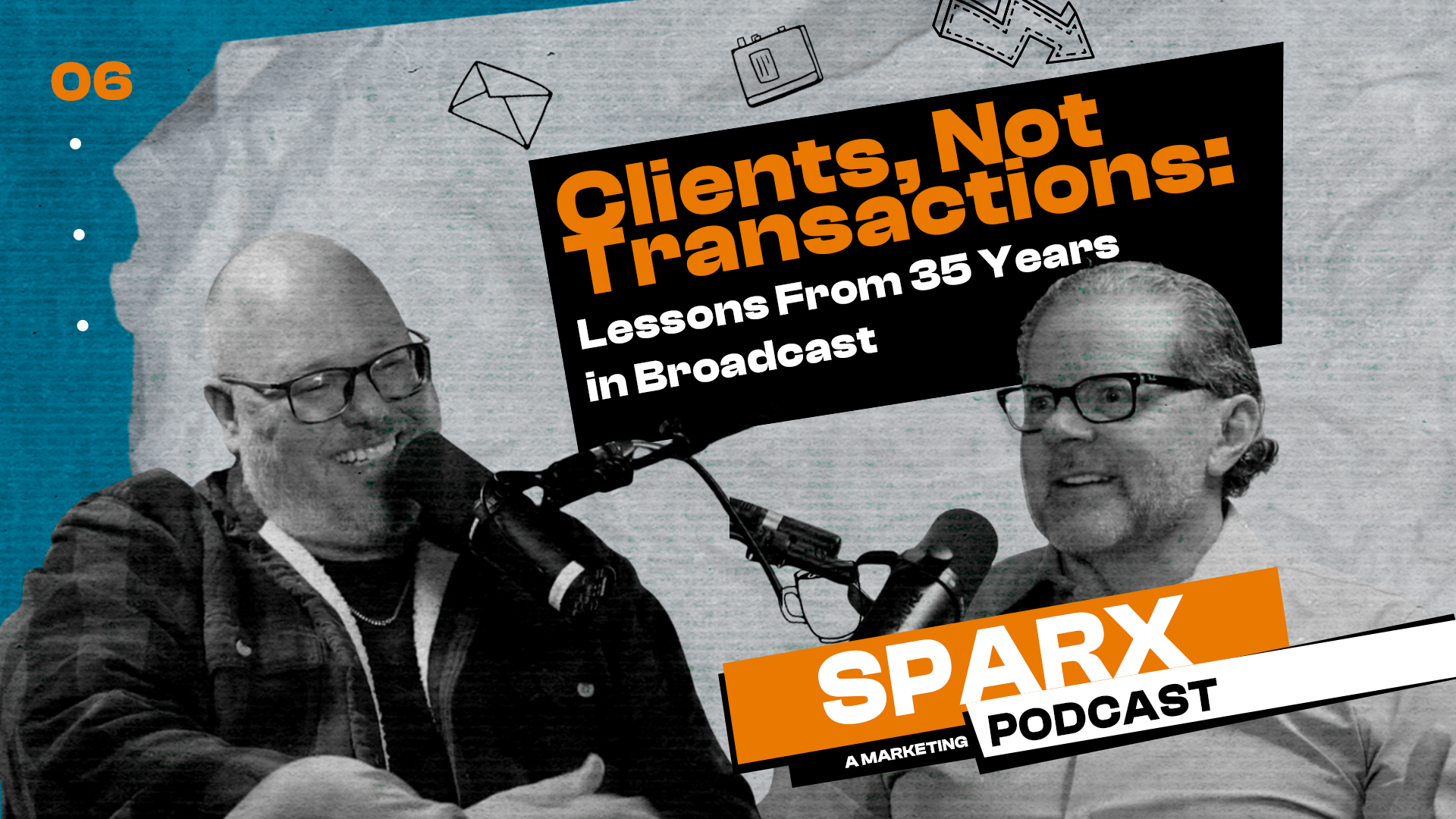

The best salespeople don’t sell a product. They become a partner the client can’t imagine working without. In this episode of the Intergetik SPARX podcast, Intergetik owner Rick Brewer sat down with his friend and longtime collaborator Jeff McCann, a broadcast media veteran with 35 years of experience.
Jeff spent 28 years with Spectrum (formerly Charter) and seven years as an account executive at KMOV Channel 4 in St. Louis, selling advertising and segments on shows like Great Day St. Louis. Today, he runs his own business, helping clients like Regenerative Neuropathy reach the right audience with a mix of TV and digital. He and Rick have worked together on projects for about four years.
This post covers Jeff’s approach to client partnerships, why cold calling was his favorite part of the job, how he decided to go out on his own, what it takes to make the jump from a corporate job, and how he balances traditional broadcast with digital marketing.
TL;DR: Jeff McCann’s goal with every client was to become an indispensable partner by looking at their business as a whole, not just selling airtime. After 35 years in broadcast, he launched his own business, which he had been quietly preparing for years. His advice for anyone thinking about the jump: know your support system, line up help for the things you aren’t good at (like bookkeeping), and weigh the pros and cons honestly. For marketing, combine TV and digital, make your website the central hub, stay in tune with what is driving results, and set clear, measurable KPIs.
In This Episode:
- Be the Indispensable Partner
- How Jeff and Rick Connected
- The Whistle Never Blows at 5:00
- Cold Calling and the Wow Statement
- Finding His Niche in Neuropathy
- Making the Jump to Small Business Ownership
- Lean on Your Support System
- Weigh the Pros and Cons
- How Broadcast Experience Shapes His Marketing
- Balancing TV and Digital
- Stay in Tune With What’s Working
- Set Clear Goals and KPIs
Be the Indispensable Partner
At KMOV, Jeff had an advantage: the station was a strong number one in the market, which made it easier to connect with clients. But he always saw his job as more than selling what the station offered. His goal was to get as far into a client’s business as they would let him.
That meant looking at the business as a whole. Sometimes it was coming up with sales ideas or point-of-purchase opportunities. Sometimes it was sharing what was working for other clients, or borrowing the best ideas from fellow account executives. Some clients opened up and shared the kind of information that could spark something big. Others preferred to keep him at arm’s length, and that was fine too.
The bottom line, Jeff said, was to always be an indispensable partner. Treating clients like transactions leads to a one-and-done relationship, and then they go looking for something else. He was also honest when another option made sense. If a client heard about something that would genuinely help, he would tell them to go for it and use it to strengthen the overall effort. Clients didn’t always expect a salesperson to advise them to spend money elsewhere, but it built trust, and it always worked out for him.
Rick said that shared mindset is what drew the two of them together. They both see clients as small business owners who need a real return on their investment. When a small business commits a budget to marketing, Rick said, that can be the equivalent of a family vacation. No one can promise to triple that investment overnight. It takes time, and it takes trust.
How Jeff and Rick Connected
Jeff turned the tables and told the story of how they met. At KMOV, the one piece missing from his sales process was a web partner. Clients kept asking for help with their websites, and while Jeff could give advice, he couldn’t do the work.
He needed someone who could build a website that does more than dump information. It had to understand the marketing and sales side, what drives the client’s business, and how to turn visitors into customers. Jeff talked with two other companies before choosing Intergetik, because Rick was the one who understood the whole process.
For any small business, Jeff said, the website is the portal. In nearly every business category, it is where people go first. Your reviews, homepage, blogs, and backlinks all work together to make it convert. Once word spread that KMOV had an unofficial web partner, he said, it was off to the races.
The Whistle Never Blows at 5:00
Rick shared the story of his parents’ print shop, which they started in 1982 and ran as a micro business for its entire life. He watched them work until midnight on projects. His dad would get up at 3 a.m. to stuff envelopes just to make it work.
As Jeff put it, the whistle doesn’t blow at 5:00 for a small business. It just keeps going. That is why both of them see small businesses as people, not paychecks. Jeff always told business owners that he admired what they were doing, because it takes so much to build a small business. People take it for granted, but no business fairy taps owners on the head. It takes blood, sweat, and tears, and there is always a great story behind it.
Cold Calling and the Wow Statement
Beyond the people and making the sale, Jeff’s favorite part of working at KMOV was cold calling. He loved walking into a business unannounced and coming up with one “wow” statement, a sharp observation about their business that made the owner want to hear more.
To Jeff, it was like a chess match. He was prepared, and they weren’t. The goal was to share just enough to get them to lean in, without going too deep, until they said, “Let me get my calendar.” Walking out with an appointment scheduled was the most gratifying part of the job.
Rick feels the same way about business development. He recently sat down with a husband-and-wife team who founded an electrical business, just to hear their story. Rick loves those conversations because there are so many entrepreneurs thriving in the Midwest.
Finding His Niche in Neuropathy
Jeff always wanted to run his own business, but he knew certain boxes had to be checked first. He never forced it. The opportunity simply became available at the right time.
Earlier in his career, Jeff served as national sales manager at Charter, handling agency business. He quickly realized two things: local sales paid better, and he missed being in front of clients. Agency work was mostly crunching numbers with very little time talking to local business owners. He moved to KMOV right as COVID began.
Around eight years ago, he started working with a client in the neuropathy space and learned the industry. That knowledge paid off when he connected with Dr. Chad Weber of Regenerative Neuropathy a little over two and a half years ago. Jeff explained that neuropathy is a progressive condition that doesn’t simply go away on its own, which means helping people find treatment early matters. Dr. Weber’s team trusted Jeff with the kind of information that let him build a consistent strategy they still rely on today. It has become his biggest success story.
Dr. Weber belongs to a national marketing consortium of neuropathy practices that share what works and what doesn’t. He was so happy with Jeff’s work that he introduced him to another practice on the East Coast, which Jeff has worked with since April. (Intergetik supports that practice too.) Jeff also has two non-medical clients, but the neuropathy work is especially gratifying because he knows he is helping people improve their lives. These practices are businesses, he said, but first and foremost, they are there to help people.
Making the Jump to Small Business Ownership
Jeff’s move wasn’t a sudden decision. About eight years ago, he formed an LLC for this exact moment. The skeleton was in place, even though the clients weren’t there yet. He wanted to be ready if the opportunity came, and when it did, the decision was easy.
So what is the biggest challenge in leaving a steady job with a paycheck, health insurance, and benefits? Jeff said there is no single answer, because everyone’s situation is different. But you have to play the what-if game and be prepared for anything that might happen.
Lean on Your Support System
Rick said the first question is whether you have somewhere to go, or someone to lean on, if you fall flat on your face. Many people don’t. Growing up around his parents’ print shop gave Rick a level of comfort with the ups and downs. Without that experience or a safety net, the risk is much greater.
Jeff said he felt he had enough support, including Rick. The one thing he wasn’t prepared for was the bookkeeping: invoicing, paying bills, and keeping the books. He first called a friend, a retired CPA in Scottsdale, just for advice, thinking he could handle it himself. He quickly realized he didn’t want to do it and couldn’t do it well. Now he gladly pays his friend to handle it. Rick added that finances, taxes, and insurance are a lot to manage logistically.
Still, neither of them wants to discourage anyone. Rick pointed out that a corporate job isn’t guaranteed either. People get laid off, pick up a hobby like making custom mugs, open an Etsy shop, and watch it take off. Many businesses grow out of nights and weekends, out of opportunities people spot because they kept one eye open, or out of a few sacrificed hours of sleep and missed ballgames. The question to ask is, what am I risking by making this decision? Or, as Rick put it, how bad do you want it?
Weigh the Pros and Cons
Jeff’s process was simple. He made a list of pros and a list of cons. The cons list was short, and the pros list was more than enough to move forward.
Peace of mind was a big factor. His commute was 50 minutes each way, nearly two hours a day in the car, and at this stage of his career, that got old fast. He liked his job, but he had been there and done that. He says he probably wouldn’t have made this move at 35 or 45, but now it is perfect timing. And he credits his focus on being an indispensable partner for getting him there faster. He didn’t need big accounts like a car dealership. The family-owned local businesses he already worked with were enough to build on.
How Broadcast Experience Shapes His Marketing
For the neuropathy practices, Jeff’s broadcast background is a perfect fit. Their core audience is adults 65 and older. Younger people may say nobody watches TV anymore, but for that demographic, TV still delivers excellent value on a cost-per-thousand basis. Jeff says he can reach adults 65 and older at a cost in the low single digits per thousand viewers, and with a 30- or 60-second spot, he can tell a story that gets people to call.
The real bread and butter, though, is long-form content on local lifestyle shows like Great Day St. Louis. Those live segments put Dr. Weber in front of viewers to talk about what he does and make a personal connection. Generic brand spots help with recognition, but they don’t always get people to pick up the phone.
That personal connection matters. Jeff noted that many patients are used to quick, 10- to 12-minute appointments. In a five-minute TV segment, Dr. Weber invites viewers to free seminars held every two weeks, where they can get their questions answered. Jeff has seen him spend 20 minutes with one person after a seminar, at no charge. As Rick put it, he isn’t treating people like transactions.
Rick added that this works well for Jeff, too. After years of taking clients to TV studios and watching them freeze when the red light came on, Jeff got to sit behind the microphone himself for this episode.
Balancing TV and Digital
TV and digital each work well on their own, Jeff said, but combined they can be even better. Every TV ad runs as a direct response campaign: show the ad, and the phone needs to ring. Great Day segments work the same way.
Digital can be more challenging for this demographic. Static Facebook ads can still work, but it is harder to get an older audience to act on them directly. Most people won’t call just because they see an ad. They do their due diligence and research first, and that usually means visiting the website.
Rick said that is exactly why the website has to be the central hub for conversions. He also sees the power in the combination. Picture someone in that 65-plus audience scrolling Facebook to check on their grandkids and seeing a patient testimonial, or a replay of a segment they already watched on the morning show. That brand recognition tells a story.
Stay in Tune With What’s Working
How do you decide where to put the budget? Jeff said you’re only as good as your last month. Response ebbs and flows, and the neuropathy business even has a seasonal component. Right now, the seminars are the big focus, so the goal is to get as much word out about them as possible.
The lesson for any business is to stay in tune with where your response is coming from. You can’t just do something because it worked for someone else, or because it worked five years ago. Things change on a dime, and next month could look completely different. If you aren’t following that, Jeff said, you’re asking for disaster.
Set Clear Goals and KPIs
For his final piece of advice, Rick asked how a business can get to know its clients better. Jeff said it starts with clearly defined goals and key performance indicators (KPIs) that are actually tracked.
Too many businesses keep it vague and say they want more sales. Everyone does. Instead, get specific. Maybe the goal is a 20% increase in foot traffic to a brick-and-mortar location each month. Then build a strategy to reach it and track the results. Ask what you are selling, what delivers the best return, and where your best margins are.
Those conversations can be tough, because clients may wonder who this person is asking questions and whether they can trust them. That is where a good salesperson earns trust with a strong statement that keeps them wanting to hear more. Jeff also recommends helping businesses find a clearly defined niche and pushing that focus from there. Rick agreed: know your goals, track your data, and let the numbers show you what is working.
To connect with Jeff and learn more about his work, find Jeff McCann on LinkedIn.
Ready for a Marketing Partner, Not a Vendor?
Jeff McCann’s career is proof that the best partnerships are built on trust, honesty, and genuinely caring about the business on the other side of the table. At Intergetik, we work the same way, building websites and campaigns that turn attention into calls, tracking what is working, and adjusting as your business grows. If you want help with your website, SEO, or advertising, let’s talk.
Never Miss an Episode
Get more SPARX conversations on marketing, growth, and the people making an impact in St. Louis and beyond. Subscribe to the Intergetik podcast and follow along. Subscribe and Listen
Want to Be Featured?
We love connecting with marketers, founders, business leaders, and industry pros. If you would like to share your story or expertise on the SPARX podcast, we would love to hear from you. Get in Touch