
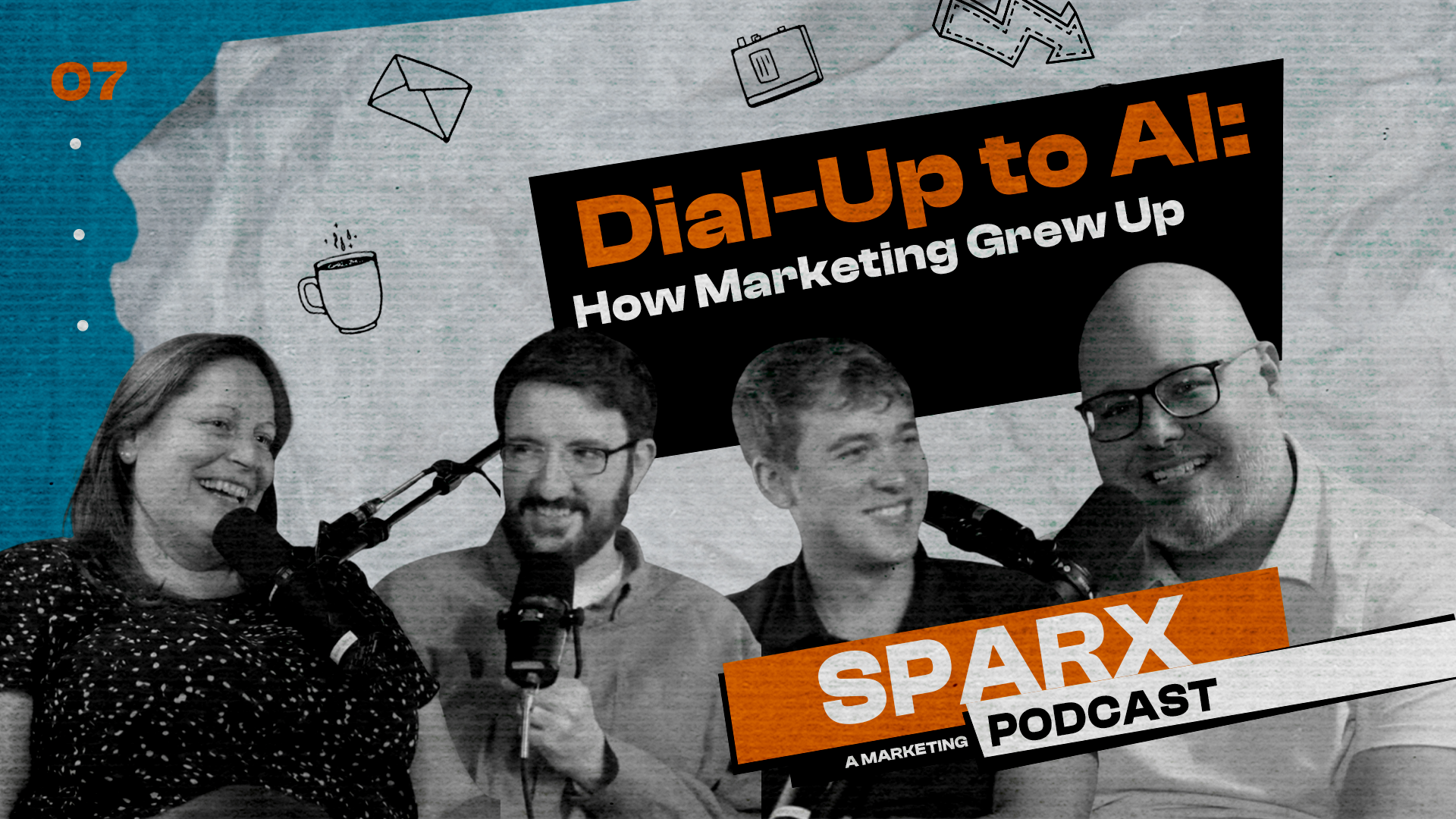

This episode of the Intergetik SPARX podcast is a little different. Instead of interviewing a guest, Intergetik owner Rick Brewer pulled up a chair with a few members of the Intergetik team for the first SPARX round table.
Joining Rick were Jeff Wynn, senior web developer and one of Rick’s oldest friends, Jacob Wingerter, account manager in St. Louis, and Jess Glyshaw, who leads operations and is lovingly known around the office as the mom of the company. Together, the group has years of experience in media and marketing, and they spent the episode talking about where marketing has been, where it is now, and the ads none of them can get out of their heads.
This post covers the team’s first campaigns, how Intergetik got its start, why caring about people comes before the transaction, the corniest marketing they remember, and how the internet, the iPhone, and AI changed the way businesses reach customers.
TL;DR: The best marketing still starts with listening to the business owner and understanding who they need to reach. Corny can work when it sticks, and the most memorable ads from Budweiser, Apple, and Nike prove it. But the iPhone turned media into something everyone carries in their pocket, the shared monoculture of TV and newspapers is gone, and AI now tailors information to each person. For small businesses, that means one Yellow Pages ad is no longer enough. Getting the phone call now takes a presence across many platforms, plus SEO, AEO, and GEO.
In This Episode:
- Listen First: Jacob’s First Campaign
- How Intergetik Got Its Start
- People Over Transactions
- Corny Marketing Has Its Place
- Jingles You Can’t Forget
- The Ads That Stuck With Us
- From the Newspaper to Your Pocket
- The End of the Monoculture
- What It Takes to Get the Phone Call Now
Listen First: Jacob’s First Campaign
Rick kicked things off by asking Jacob about a marketing tactic he remembers from his early days in media sales. Jacob pointed to one of the first creative strategies he ever built, for a flooring store. He put together a blend of digital tactics: digital display, Google paid ads, and a targeted email campaign.
The reason it worked, Jacob said, applies to every client. You have to sit down with the business owner and really listen. Understand where the problem lies, where they need to find business, and who they are trying to reach. When you narrow it down that way, every tactic can work in tandem. That first campaign drove something like a 200% increase in website visitors, clicks, and traffic, and it turned into more sales. It was the first moment Jacob realized he could make a real difference for a small business with the right strategy.
Rick agreed. That is the foundation Intergetik was built on: understanding small and midsize businesses and building partnerships that are actually profitable for them.
How Intergetik Got Its Start
Intergetik started as a small freelance gig. The earliest projects date back to the middle of 2006, and Jeff, who still keeps a list of everything the team has worked on, confirmed the timeline.
Rick remembers a health clinic coming to him for a website. Playing the Steve Jobs to Jeff’s Steve Wozniak, Rick said yes, then ran down the street to Jeff’s house and asked if he could code a website. Jeff had done some hobby projects (more than just a MySpace page, he clarified) and picked up some HTML and JavaScript books. The rest is history.
Rick admits that in his early twenties, every opportunity felt like a transaction. The thinking was mostly, we’re going to make money on a website. Over time, he learned the real value is producing a return on investment for the client. A nice website doesn’t automatically bring in profit.
People Over Transactions
Jess came to marketing from the food and beverage industry, so Rick asked what it is like to sit down with a small business owner for the first time.
What Jess has come to love about Intergetik’s approach is that the team cares about the person, the owner, and their team before it cares about the services. That is the difference between a small business and a large corporation. For a small business owner, a sale can be the difference between putting food on the table for their family or not.
When a small business hires a marketing agency, they are trusting that agency with their livelihood. Jess said that is weighty. Understanding the person and the family behind the business first is what helps the team figure out how to make them money. Rick added that it comes down to customer service and genuinely caring about people, which he called a lost art in any industry, and the center of everything for a professional services company.
Corny Marketing Has Its Place
Rick then asked the group for the corniest marketing they have ever done or seen.
Jeff remembered a trade show banner for Direct Freight, one of Intergetik’s early clients. The goal was to help carriers get more exposure for their loads on the Direct Freight load board. The banner showed a man and a woman cropped from the shoulders up, implying they weren’t wearing much, with the headline “Expose Yourself.” The owner’s wife wasn’t so sure about it, but people raved. Plenty of trade show visitors stopped to take pictures with it, and the owner said it got people talking about the company. (A follow-up idea, “Drop Your Load,” did not make the cut.)
Jingles You Can’t Forget
Jacob said corniness has a time and a place, and the team had recently been talking about jingles that get stuck in your head. Growing up in St. Louis in the early 2000s, he still hears one every time he walks into work: “Six is a serious number,” from an On the Run promotion tied to the Cardinals scoring six runs.
The group rattled off a few more, including a local roofing jingle (“for a hole in your roof or a whole new roof”) and Tom Bodett’s line for Motel 6, “We’ll leave the light on for you.” Jacob said that kind of corniness can build a lot of brand recognition if it sticks in the consumer’s mind.
The Ads That Stuck With Us
The first campaign that came to Jess’s mind was the Budweiser frogs: one frog croaked “Bud,” the next “Weis,” and the last “Er.” She called them silly but completely memorable. She also remembers when Super Bowl commercials were only released during the game, and the commercials were the real reason to watch. Jeff even remembers getting a Budweiser frog hat as a kid.
The group also remembered Carrot Top’s 1-800 commercials, a big deal in the late ’90s and early 2000s. Rick brought up two of the most talked-about campaigns in advertising history: Apple’s “1984” commercial, a play on George Orwell’s novel that introduced the Macintosh, and Nike’s “Just Do It.” For anyone who wants the story behind Nike, Rick recommends Shoe Dog by Nike co-founder Phil Knight.
Rick is also a big fan of Mad Men. He is quick to say he is nothing like Don Draper, but he loves watching how the show dramatizes the creative process and the big pitch at a New York ad firm. And it shows how much the industry has changed. Today, marketers don’t have to work from the 40th floor of a Manhattan high-rise. Rick pointed out that Evie Gerhart, Intergetik’s project manager, can run marketing for a company from an RV park in Arizona, hundreds or thousands of miles away.
From the Newspaper to Your Pocket
Jess said that change is really the evolution of the internet. Marketing used to live on TV, in print, in magazines, and in newspapers, and none of those hold the same place they once did.
Rick remembers reading the Everyday section of the St. Louis Post-Dispatch as a kid, and seeing ads, including Apple’s, right in its pages. Jeff remembers the free cereal samples that used to come with the newspaper. (He also confessed to once collecting every cereal box in the neighborhood with his brother and a friend.) Rick was an Archie comics reader. Jacob pointed out that nobody keeps a newspaper or magazine by the bathroom anymore. It’s all YouTube Shorts on your phone.
As Rick put it, the internet changed everything, including the marketing industry. Marketing is no longer just about how cute a logo looks or how great a brochure or newspaper ad is. It’s about getting anyone with the right search or need to convert on a client’s website through advertising and mixed media.
So when did the shift really happen? Jess pointed to the release of the iPhone in 2007. People went from cell phones they may have shared with a family member to computers in their pockets. Since then, everything has snowballed. The more there is to consume and the more apps there are, the faster it moves.
The End of the Monoculture
The group also talked about how AI is speeding things up even more. Rick described it as having an entire floor of newspaper editors tailoring every piece of information to your exact interests. Jess pointed out the downside: it can trap you in an echo chamber where you never hear opposing views unless you specifically ask for them.
That ties into what Rick called the end of the monoculture. In the ’80s and ’90s, everyone watched the same shows and waited for the same finales, from Cheers to Seinfeld to Friends. Today, nobody is watching the same thing. Jacob said the team’s shared Spotify playlist is proof: the music is so eclectic that nobody in the room is singing the same song as the person next to them. People take their cues from social media and from the people they trust, not from one shared set of ads.
What It Takes to Get the Phone Call Now
That splintering has reshaped marketing for small businesses. A Yellow Pages ad used to be enough because that is what everyone used. Now, as Rick put it, a business has to show up on many different platforms and run many different campaigns, while also investing in SEO, answer engine optimization (AEO), and generative engine optimization (GEO), just to get the phone call.
The team plans to pick up there in the next round table, digging into how marketing made that transition and all the avenues businesses use today.
Ready to Get Found Everywhere Your Customers Are Looking?
The SPARX round table is a reminder that the tools change, but the approach that works does not. Listen to the business owner, care about the people behind the business, and build a strategy that turns attention into revenue. If you want help with SEO, advertising, and showing up on the platforms and AI tools your customers use, let’s talk.
Never Miss an Episode
Get more SPARX conversations on marketing, growth, and the people making an impact in St. Louis and beyond. Subscribe to the Intergetik podcast and follow along. Subscribe and Listen
Want to Be Featured?
We love connecting with marketers, founders, business leaders, and industry pros. If you would like to share your story or expertise on the SPARX podcast, we would love to hear from you. Get in Touch