

Introduction
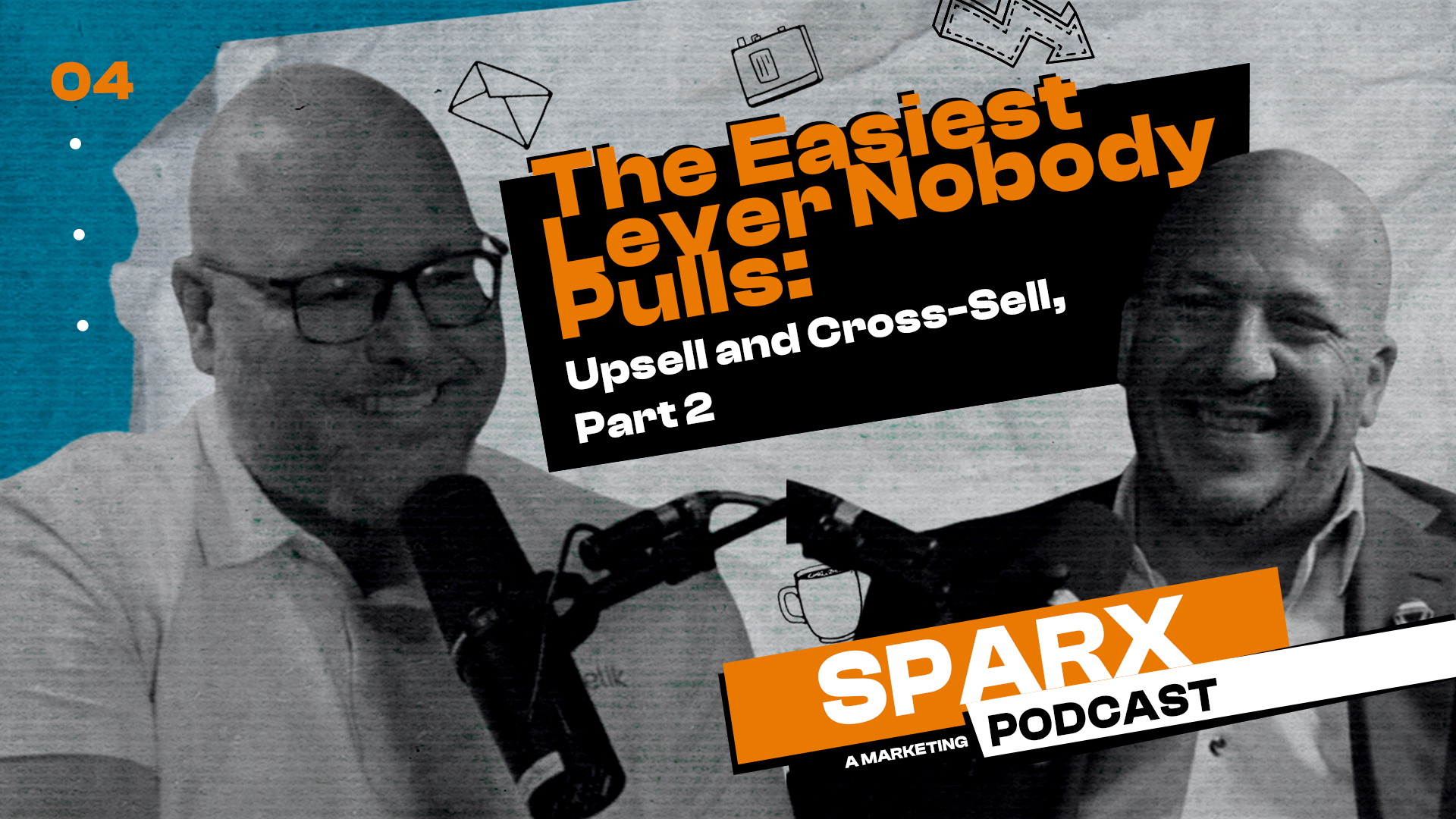
In part 1 of our conversation with Matt Lanzone, Matt laid out his four levers of revenue growth and made the case that most small businesses overlook the biggest opportunity they have: the clients they already serve. In part 2 of this two-part episode of the Intergetik SPARX podcast, Intergetik owner Rick Brewer and Matt dig deeper into lever two, upsell and cross-sell.
Matt is a fractional revenue growth executive with Executive Consulting Group (ECG) in St. Louis, a former CRO and COO, and a certified Six Sigma Black Belt. This post covers the difference between upsell and cross-sell, what wallet share really means, how to grow accounts without making clients feel squeezed, where marketing fits in the ecosystem, and what Matt looks at in his first 90 days with a new client.
TL;DR: Upsell means moving an existing client to a bigger package as their needs grow. Cross-sell means introducing new products, including offerings from sister companies or other business lines. Both grow your wallet share, and lever two is the least costly lever to pull because those leads are already warm. Do it with a servant mindset and the goal of leaving every client better than you found them. To start today, get a real understanding of your client base with a CRM, and as you grow, give your salespeople clear roles.
In This Episode:
- Upsell vs. Cross-Sell: What’s the Difference?
- What Wallet Share Means for a 12-Person Shop
- Cross-Selling Across Silos: The Pay Card Story
- Your First Move on Monday Morning
- Serving, Not Squeezing
- Where the Framework Clicks: Accountability
- Lever Four: Marketing as Your Growth Engine
- Operations Has to Keep Up
- The First 90 Days as a Fractional CRO
- Put Lever Two to Work Today
- Who Matt Works With and How to Reach Him
Upsell vs. Cross-Sell: What’s the Difference?
Upsell and cross-sell are common terms in the business world, and plenty of people use them interchangeably. Matt draws a clear line between the two.
Upsell is about growing an existing client into a bigger package. Say a client came in at a bronze level. Things are going well, their company has grown, and now they probably need the silver or gold package.
Cross-sell is about introducing new products. That can mean a new offering from your own company, or it can mean connecting clients to a sister company or another line of business that has been operating in its own silo.
What Wallet Share Means for a 12-Person Shop
Rick asked Matt to explain wallet share the way he would to the owner of a 12-person shop. Matt’s answer: picture a client with $100 in their wallet. Through research, you know you could deliver $100 worth of value to that client. Right now, though, they might be spending $36 with you and the rest with a competitor or somewhere else. Growing your wallet share means earning more of that $100.
This is where two more terms come in: total addressable market (TAM) and ideal client profile (ICP). If you know what your ideal client looks like and what they typically spend, you can look at your existing base and spot the gap. Matt’s example: if your ideal client spends $100 and 30% of your client base is only spending $20, there is another $80 to go after with each of them. That is why knowing your customer base is so valuable.
Cross-Selling Across Silos: The Pay Card Story
Matt’s favorite cross-sell example comes from his time at Ceridian, now Dayforce. After a short stint away from the company, he was asked to come back and lead the cross-sell team, so this lever is near and dear to his heart.
Ceridian handled payroll and direct deposit for its clients. It also had a sister company, Comdata, that provided stored value cards for over-the-road truckers. On the surface, one looked like a trucking company and the other looked like a human capital management company. They operated in their own silos.
Then the team asked a simple question: what if there were a third way to get paid? Employees could split their pay between a checking account, a paper check, and a pay card, the forerunner of the modern debit card. For workers on the road, it was a safer and more convenient option. By connecting two business lines that seemed unrelated, the company opened up a whole new cross-sell opportunity across its existing client base.
That is the key, Matt says. Look for ways to cross-sell and cross-pollinate your existing clients.
Your First Move on Monday Morning
So what should a business owner do first if they want to expand? Start by deciding which of the four levers to pull:
- New logos: going out and finding new clients
- Upsell and cross-sell: growing your existing base
- Channels and partners: leveraging the network you already have
- Marketing: building awareness and demand
Every one of those motions costs money. New logos come with a customer acquisition cost (CAC). Channels and partners need to be fed. Marketing requires an investment. But Matt says the least costly lever is upsell and cross-sell. Those leads are already warm, you have already built rapport, and a conversation with an existing client is far more likely to close than a cold opportunity.
Serving, Not Squeezing
Many business owners hesitate to pull lever two because they don’t want to pressure their clients. Rick shared that he has felt the same way, wondering whether to bring up SEO with a client who was already investing in other services. He even tells clients not to sign on if it would put them in an uncomfortable spot financially, because he wants them to see a real return on their investment.
Matt says avoiding that squeezed feeling starts with company culture. His team knows a few of his favorite sayings, which they call “Lanzonianisms,” and one of them is to have a happy heart and an open mind. Add a servant mentality and a commitment to leave people better than you found them.
In practice, that means a cross-sell conversation can be a win even when the client says no. If you explain a new SEO program and the client decides not to buy, you have still left them better educated and able to make informed decisions in the future, even if they eventually buy from someone else. You honor your client. Knowing the wallet share opportunity is smart, Matt says, but you pursue it in an honorable way. If a client says they are not interested, that is fine.
As Rick put it, treat people the way you want to be treated.
Where the Framework Clicks: Accountability
Matt recently walked two different prospects through the four levers and the three Ps that support them: people, product, and process. Both landed on the same takeaway without any prompting: accountability.
That was exactly the point. The levers are what you are tasked with pulling. The people, product, and process are what make it possible. And accountability is what makes sure it actually gets done.
Lever Four: Marketing as Your Growth Engine
Marketing is where Rick and the Intergetik team make their living, so he asked Matt to make the case for lever four.
Matt sees marketing as your growth engine. It drives leads and lead generation, but the real reason comes down to something simpler. Business owners are in business because they created something great, whether that is the springs they manufacture, the advice they give, or the food they serve. They believe in their product and want everyone singing its praises. Marketing is how you get that message out from one to many.
Rick agreed, with one important caveat: you can’t market a bad product or a bad service. He has seen businesses bring a product to the table that wasn’t going anywhere, or deliver poor service, and no amount of marketing could fix that. When the product is strong, though, marketing is a lever that should always be moving.
Operations Has to Keep Up
Rick also acknowledged that sometimes businesses need to pause marketing. When leads are pouring in faster than the team can handle, it makes sense to look inward and make sure operations can support the growth before scaling again.
That is where Matt’s background as both a COO and a fractional CRO stands out. He can see how to bring in sales, and he can also see when operations won’t keep up. Give it time, and the wheels fall off the wagon if operations isn’t in step with sales.
Matt says this is the beauty of the whole ecosystem. Marketing feedback tells you what is landing and what is not, which can reveal problems in how you present your product. Customer feedback might reveal demand for something you don’t offer yet, which opens the door to a new product line. Upsell, cross-sell, new logos, channels, and marketing all feed one another, supported by the right people, product, and process.
Rick noted that Intergetik runs on EOS, the Entrepreneurial Operating System, and sees a lot of the same thinking there. As someone who thrives on the sales and creative side, he relies on a strong team to keep operations on track.
The First 90 Days as a Fractional CRO
When Matt steps into a new client as a fractional CRO, the first thing he wants to understand is the culture. That doesn’t mean the culture is usually bad. He just wants to understand it, and good questions reveal it quickly.
In the first week, Matt typically holds one-on-ones with the teams he will work with. Then he gets everyone on the revenue and customer side into one room for a SWOT analysis: strengths, weaknesses, opportunities, and threats. The exercise shows him the group dynamic, including who talks a lot and who stays quiet, so he can respect how each person likes to communicate. It also surfaces disagreements. Inevitably, one person lists something as a top strength, and someone else names that same thing as the biggest weakness.
From there, Matt runs a kaizen, a Six Sigma practice whose name comes from a Japanese word meaning good change or improvement. The goal is to get everyone together and on the same page before anything gets put in motion.
Matt used pizza to explain why this matters. He might love a supreme pizza and assume everyone else will too. In meetings, he sees the same thing with communication. One person wants updates through Slack, another wants a text, and another wants a phone call. Put ten people in a room and you may find ten different preferences. The point is to ask instead of assume. (For the record, Rick prefers face to face.)
Put Lever Two to Work Today
If a listener wants to start pulling lever two today, Matt’s advice is to understand what your existing client base looks like. That sounds like a no-brainer, but it requires a real tool. Many businesses think they have a CRM when what they really have is a glorified spreadsheet, or they have a CRM and don’t use it. You have to commit to understanding your client base.
From there, it comes back to the three Ps. As your business grows, Matt recommends role clarity for your salespeople. When you are starting out, everyone does a bit of everything, and hybrid roles are normal. But the people who are wired to go after new logos are often wired differently from the people who grow and manage existing accounts. These are often called hunters and farmers. Matt isn’t a huge fan of the analogy (he jokes that farmers have guns too), but the point stands. Once you have grown enough, define the roles.
Who Matt Works With and How to Reach Him
Matt spent the first half of his career in corporate roles, and he still works with very large companies that need an outside perspective. As one client told him, everyone already has a day job, so having someone come in, ask questions, and bring fresh eyes can be invaluable.
The businesses he enjoys most, though, are owner-operated and family businesses, especially those handing off to a second or third generation. He generally works with companies doing anywhere from $10 million to $150 million in annual revenue, and he has worked across manufacturing, construction, HR, and hospitality. A St. Louis native born and raised in the city, Matt says he simply likes people who build things.
Most of Matt’s business comes through word of mouth, and he would rather you just call. You can reach Matt Lanzone at 314-413-2038, by email at matt@execconsultinggroup.com, or on LinkedIn.
Ready to Pull Every Lever?
Lever two might not be the flashiest way to grow, but as Rick put it, it may be the easiest. Understand your clients, serve them well, and look for ways to solve more of their problems. When you are ready to put lever four to work, Intergetik can help you get your great product in front of the right people and track what is working.
Never Miss an Episode
Missed the beginning of this conversation? Catch part 1 with Matt Lanzone, and subscribe to the Intergetik podcast for more SPARX conversations on marketing, growth, and the people making an impact in St. Louis and beyond. Subscribe and Listen
Want to Be Featured?
We love connecting with marketers, founders, business leaders, and industry pros. If you would like to share your story or expertise on the SPARX podcast, we would love to hear from you. Get in Touch