
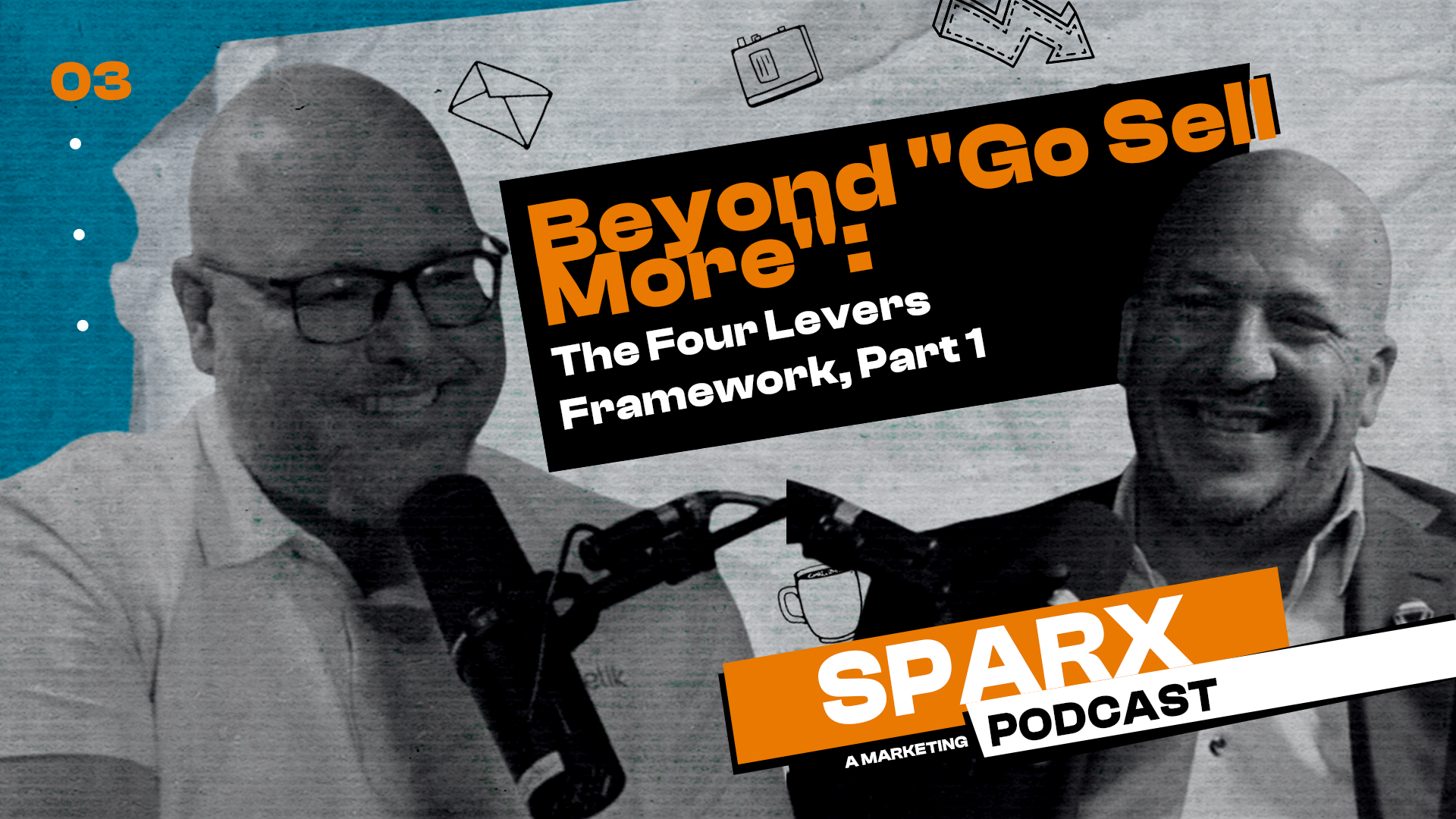
Most small business owners know how to chase new customers. Far fewer have a system for growing the customers they already have. In part 1 of this two-part episode of the Intergetik SPARX podcast, Intergetik owner Rick Brewer sat down with his friend Matt Lanzone, a fractional revenue growth executive and chief connecting officer at Executive Consulting Group (ECG) in the greater St. Louis area. Matt has held CRO, COO, and national sales leadership roles, and he is a certified Six Sigma Black Belt.
This post covers the framework Matt uses with every client: the four levers of revenue growth, the three Ps that support them, and why the most underused lever for most small and midsize businesses is the client base they already have.
TL;DR: Matt Lanzone’s four levers of revenue growth are new logos, upsell and cross-sell, channels and partners, and marketing. They work as an ecosystem, supported by the three Ps: people, product, and process. Most small businesses lean almost entirely on lever one and overlook lever two. Simply paying attention to your existing clients, listening to the voice of the customer, and measuring results can produce a 10 to 30 percent lift in revenue.
In This Episode:
- From the Restaurant Floor to Revenue Leader
- The Four Levers of Revenue Growth
- The Three Ps That Hold It All Up
- Why Small Businesses Get Stuck on Lever One
- The Most Underused Lever: Upsell and Cross-Sell
- Two Books Worth Reading
- Listen to the Voice of the Customer
- Why Marketing Is Lever Four
- The Four Box: Be Important and Unique
- The 10 to 30 Percent Lift Hiding in Your Client Base
From the Restaurant Floor to Revenue Leader
Matt’s sales education started long before his first corporate job. He grew up in the restaurant business at Bartolino’s, the St. Louis Italian restaurant group now in its third generation of family ownership, working his way from busboy to server to manager.
That job taught him a lesson he still uses today. He would show up for a shift with almost nothing in his pocket, and how much he took home depended entirely on the next eight to ten hours. The servers who did best knew their regulars by name and remembered their usual drinks. They knew the menu well enough to answer any question about a dish. And they followed a process, like greeting every table within 30 seconds. As the staff used to joke, either you or your replacement would greet the customer within 30 seconds.
Without realizing it, Matt was already learning the foundation of his framework: know your customer, know your product, and have a process. Do those things well, and people pay you more for it.
As a student at Fontbonne University, Matt landed an internship at Ceridian, now known as Dayforce, a human capital management company. He started as a support analyst learning the product and the process, then moved into frontline business development, making 100 to 300 cold calls a day back when the CRM was essentially a phone book. From there he moved into product demos, then a sales territory of his own, and eventually into leadership of small teams, then regional teams, and beyond.
Ceridian is also where Matt earned his Six Sigma Black Belt. After a private equity acquisition, the company brought in CEO Kathy Marinello, who came from GE during the Jack Welch era and built a culture around process discipline. (Rick admits he wants to start singing about kung fu every time he hears “black belt,” but Six Sigma is all about operations, measurement, and process improvement.) Pairing his natural sales instincts with that process training is what eventually led to Executive Consulting Group.
The Four Levers of Revenue Growth
Matt’s framework centers on four levers that protect and grow revenue for a healthy company:
- New logos. Go out and win new clients. Think of a NASCAR car covered in sponsor logos: the more logos on the car, the more revenue.
- Upsell and cross-sell. Take care of your existing client base, understand it, and earn a greater share of each client’s wallet.
- Channels and partners. Leverage your network. With insight from levers one and two, partners can advocate and sell on your behalf.
- Marketing. Build awareness and demand that feeds the other three.
The key is that the levers are not separate tactics. They form an ecosystem, and when all four work together, each one feeds the others.
The Three Ps That Hold It All Up
Underneath the four levers are the same three Ps Matt learned waiting tables: people, product, and process. Strong foundations in all three are what Matt calls enablement, because they enable your team to go out and protect and grow revenue.
The final piece is accountability. This is where Matt’s Six Sigma background shows up most. You need to measure how each lever is performing so you know what is working and what needs to change.
Why Small Businesses Get Stuck on Lever One
Today, Matt focuses on companies with roughly $10 million to $100 million in annual revenue. These are usually owner-operated or founder-led businesses, and they are entrepreneurial by nature. Their instinct is to go out and find new customers.
In the beginning, that is exactly right. When you have no clients, new logos are the only lever you can pull. The problem is that many businesses never shift gears. They keep chasing new logos and overlook the opportunities sitting inside their existing client base.
Matt is quick to point out that these owners still take good care of their clients. They just miss the chance to sell more and create a better experience for the people already working with them. And because acquiring a new customer costs money, failing to grow existing accounts means leaving lifetime value on the table.
The Most Underused Lever: Upsell and Cross-Sell
When Matt walks into a business, the lever he most often finds underused is lever two. Your existing clients already know you, trust you, and are your best source of new opportunities.
Many business owners shy away from it, especially if they are not natural salespeople. They worry that offering more will feel like pressuring the people they serve. Matt’s advice: it is okay to ask your clients if they want to buy more from you. You don’t go in guns blazing asking what they are going to buy today. You have real conversations, listen well, and look for ways to solve more of their problems.
Two Books Worth Reading
Matt recommended two books for anyone who wants to dig deeper into growing existing accounts:
- Outgrow by Alex Goldfayn. Goldfayn makes the case for concentrating on your existing client base as a path to predictable, organic sales growth.
- The Listening Advisor by John Gatewood. Released this year, it focuses on listening to your clients, both to serve them well and to understand what else they need.
Listen to the Voice of the Customer
Here is where the levers start working together. Your partners and marketing team need information to do their jobs well, and the best source of that information is your clients. Six Sigma calls it the voice of the customer, or VOC. Your clients will give you honest feedback if you give them the chance.
Rick shared how Intergetik puts this into practice. The team set up an automated quarterly report card that asks clients how Intergetik is doing, where it could do better, and whether they are seeing the results they want. Meeting expectations is the minimum, Matt said, the ticket to play. But those same conversations are where clients start saying things like, “I love what you’re doing for me. Have you ever thought about adding this?”
Rick has seen that firsthand. Client conversations have led Intergetik to build at least two new lines of business, including its CRM work. Intergetik could measure leads coming in from Google Ads and SEO, but many clients were tracking what happened next with pen and paper or spreadsheets. With no trackable metrics, nobody could tell which leads turned into qualified opportunities. Setting up CRM platforms like Salesforce and HubSpot to follow each lead through the pipeline solved that problem, and it started because clients said what they needed.
Why Marketing Is Lever Four
Rick had to ask the obvious question for a marketing agency: why is marketing listed fourth?
Matt’s answer is that the levers are not ranked by importance. The order reflects how a business typically evolves. First you find new clients. Then you grow the clients you have. Then you scale through channels and partners. Marketing often comes last because it requires spending dollars, but it is crucial. No single lever outranks the others, and all four need to work in tandem to really drive the whole organization. (And for the record, Matt said marketing is number one in his book.)
The Four Box: Be Important and Unique
Another Six Sigma tool Matt uses at ECG is a simple four-box grid. On the X axis is how important something is to your customer. On the Y axis is how unique it is to you.
Where you want to play is the top-right box: things that are highly important to your customer and highly unique to you. If something is not important to your customer and not unique to you, there is no reason to talk about it, and it is easily replaced. Focus on what makes you irreplaceable, and make sure your customers know about it.
The 10 to 30 Percent Lift Hiding in Your Client Base
So how much opportunity is sitting inside a typical client base? According to Matt, just paying attention to the ideas in this conversation and doing the basics well can produce a 10 to 30 percent lift in revenue.
The catch is that you have to measure it. Data drives accountability, and you can’t know how you are doing unless you are tracking it. As the Six Sigma saying goes, what gets measured gets improved.
Rick agreed that this is core to how Intergetik works. Creative work is hard to evaluate on its own, but traffic, impressions, clicks, and conversions can all be measured. When you track the numbers, you can see which levers are moving the business forward.
To learn more about Matt’s work helping growing companies protect and grow revenue, connect with Matt Lanzone on LinkedIn.
Coming up in Part 2: Rick and Matt continue the conversation. Stay tuned for the next episode of the SPARX podcast.
Ready to Put Your Marketing Lever to Work?
Matt Lanzone’s four levers are a reminder that growth is not just about chasing new customers. Listen to the clients you already have, measure what matters, and make sure every lever, including marketing, is working together. If you want a marketing partner that tracks real results and helps you turn data into growth, let’s talk.
Never Miss an Episode
Get more SPARX conversations on marketing, growth, and the people making an impact in St. Louis and beyond. Subscribe to the Intergetik podcast and follow along. Subscribe and Listen
Want to Be Featured?
We love connecting with marketers, founders, business leaders, and industry pros. If you would like to share your story or expertise on the SPARX podcast, we would love to hear from you. Get in Touch