
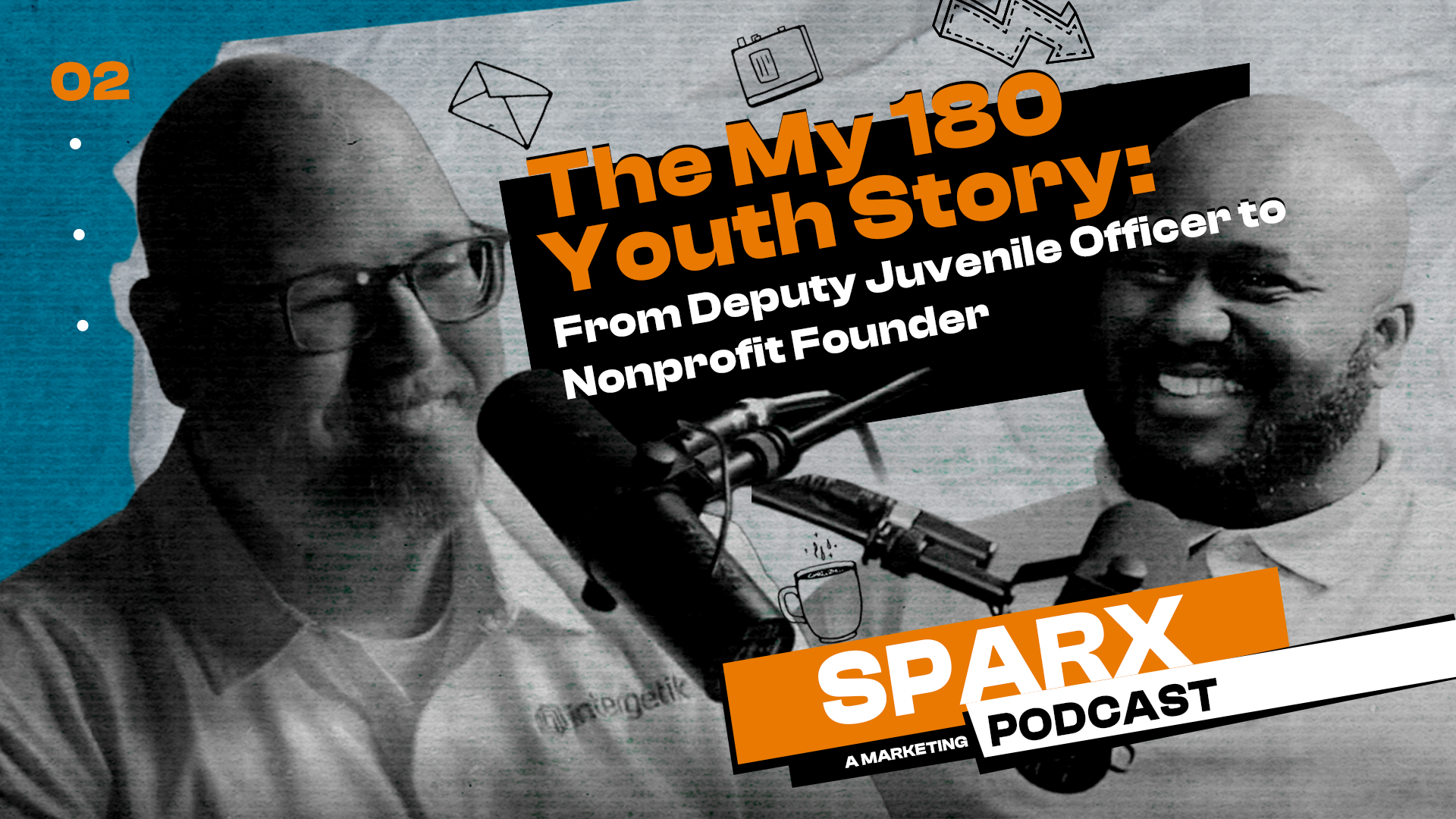

Some of the best lessons about loyalty, trust, and growth don’t come from the business world at all. In this episode of the Intergetik SPARX podcast, Intergetik owner Rick Brewer sat down with his friend Roy Jefferson, founder and executive director of My 180 Youth Program. The St. Louis nonprofit has mentored young people ages 10 to 18 since 2012. Roy started as a deputy juvenile officer for the state of Missouri, and over 14 years he has built an organization that runs on one principle: people need people.
This post covers the biggest ideas from the conversation: how a single volunteer visit turned into a life’s work, why his programs are built on relationships instead of a curriculum, how he grew for over a decade without a marketing budget, and what business owners can learn from him about staying relational as they grow.
TL;DR: Roy Jefferson turned a court diversion pitch into My 180 Youth, a relationship-centered mentoring nonprofit where about 85% of youth in the original program did not reoffend. He self-funded the work for 10 years, found most of his donors through the families he served, and puts every dollar raised directly into programs. His message for business owners: never let growth make you transactional. Show up, do the work first, be yourself, and build relationships that last.
In This Episode:
- From Deputy Juvenile Officer to Nonprofit Founder
- One Visit Turned Into Three Years
- Five Programs Built on Relationships, Not Curriculum
- Trust Is Built in the Hard Moments
- What Relationship-Centered Looks Like on a Tuesday Afternoon
- Growing for 14 Years Without a Marketing Budget
- Why Transparency Wins Supporters
- The Lesson for Business Owners: Don’t Become Transactional
- The Best Pitch Is “Just Be Yourself”
- Drop the Mask
- What’s Next for My 180 Youth
From Deputy Juvenile Officer to Nonprofit Founder
Roy’s path to founding My 180 Youth started with a layoff. He was working at a juvenile detention center when state budget cuts and juvenile justice reform left everyone on staff without a job. He took work at a service station, and one day a deputy chief juvenile officer from his old office came through, told Roy he felt terrible about the layoffs, and said he was working on something.
About a year and a half later, Roy got the call. A position had opened, and the office wanted him to pitch a program. After time in prayer and deep thought, the idea for My 180 came to him. He presented it in the interview, the chief loved it and offered to write a grant around it, and Roy was hired to run My 180 as a minority court diversion program.
The goal was to help a Missouri county reduce minority referrals, since Black youth were about four times as likely to come in contact with the juvenile justice system. Over three years running through that juvenile office, roughly 85% of the youth in the program did not recidivate, meaning they did not reoffend on the same charge. The kids who received encouragement, support, and attention did not come back to the court system.
The program grew so quickly that Roy’s supervisor told him he had something big and needed to turn it into a nonprofit and get it out of his office. A local church offered a classroom, and My 180 Youth Program was on its own.
One Visit Turned Into Three Years
Roy is candid that he did not start with a curriculum, and in the beginning he did not know exactly what he was doing. His first step into youth work came in 2009, when a church elder told him to go with a man named Ben to talk to kids in Missouri Division of Youth Services residential treatment centers.
Roy said no. More than once. The elder did not accept that answer, and as Roy and Rick agreed, you do not deny the elder. So he went, mostly out of obedience.
One visit turned into three years. Every Sunday, Roy met with those kids, connecting with them on their interpersonal goals like peer selection and staying away from substances, and sharing a Christian message. That experience built the foundation for everything that followed. He came away understanding that these kids needed someone who could connect with them, show them love, and not label them based on what they had done.
Five Programs Built on Relationships, Not Curriculum
Today My 180 Youth runs five programs: Youth Mentoring, Moral Reconation Therapy, Academic Tutoring, Empower Leadership, and Empower Fridays. All of them grew out of the same relationship-first approach.
Mentoring happens in two formats. Small groups are organized by age, with one group for 10 to 13 year olds and another for 14 to 18 year olds, so conversations stay relevant. The kids choose the activities themselves through a group text: Sky Zone, City Museum, whatever the group votes on. Roy’s rule is simple: if he is bored sitting in an office, the kids are bored too. So they get out into the community, and while everyone is having fun, the real conversations happen. How’s school? How’s home? How are your grades? Every outing ends with a meal before the kids get dropped off at home.
The small groups are intentionally peer to peer, too. Roy wants the kids building new bonds and friendships with each other, not just with their mentors. From those group check-ins, a young person might ask for one-on-one time, which is more direct and focused on what is happening at home and what they need. Lately, Roy has been asking a pointed question in those sessions: what do you need from me that you’re not receiving?
Empower Fridays focuses on technology, creativity, and hands-on experiences. The two activities kids connected with most were podcasting and fashion merchandising. They built their own brands in Canva, used AI tools to shape their elevator pitches, and then used a heat press to put their designs on shirts. Watching them peel back the film and see what they imagined come to life was a highlight, and some of the quieter kids really opened up in that new setting.
Trust Is Built in the Hard Moments
How long does it take for a young person to trust a mentor? Roy says it depends. Plenty of younger kids show up for the fun outings at first. Real trust usually does not arrive until something shakes their world: trouble at school, conflict with a parent, or the death of a loved one. In those tender moments, the guard comes down and you are finally talking to the real person.
He shared the story of a 16-year-old who had just gotten a car and a part-time job and was getting ready for prom. When Roy asked what he needed, the answer was simple: a haircut. Roy set him up with the barber he works with. After the cut, the young man told Roy that he had been closer to him than his own father, and that the last conversation he had with his father ended with his dad saying he never wanted to speak to him again.
Moments like that happen more often than you might expect. Roy has had young men tell him they have a stepfather, a biological father, and now him. Another introduced Roy to a gas station clerk as his “pops.” Roy admits these moments hit close to home, since his own father was not there for him either. Stepping into this role helps heal wounds for the kids, and at the same time, it helps Roy pour from a place he was never poured into himself.
What Relationship-Centered Looks Like on a Tuesday Afternoon
Not every relationship clicks right away. Roy is currently working with a 13-year-old who enrolled in July and answers every question the same way: “I’m good.” “I’m fine.” There is clearly a lot going on in his family, but the trust is not there yet.
So Roy is patient. They keep going on outings and doing activities, and he keeps reminding him that he is there and that he or his mom can reach out any time. Over time, the goal is for Roy to stop being just a resource and become a trusted person. As Rick put it, trauma is trauma and pain is pain, no matter how old you are.
That philosophy extends to the whole family. When families enroll, Roy tells them they are family, and every message goes out with “Hey, family.” The office keeps food and drinks for anyone who needs them, and about two years ago they added a washer and dryer for youth and alumni who could not wash their clothes. Alumni, some as old as 25, still come back when they need support. One 19-year-old alum with no parents or grandparents in the picture was couch surfing, so Roy helped him get into a shelter, and he just enrolled at St. Louis Community College to study automotive. Roy’s approach is to give these kids the supports he wishes he had received when he was younger.
Growing for 14 Years Without a Marketing Budget
My 180 Youth has raised money, written grants, and recruited mentors for 14 years with no marketing budget. Everything has been grassroots, and most of it traces back to one source: the families the program serves.
One mom introduced Roy to someone new to St. Louis who wanted to make a big impact, and after a conversation where both sides shared their hearts, they decided to partner. Another parent had a relative at a large healthcare company who opened doors to funding. Another parent’s connection to Boeing brought in more support. The families were impressed with the work, and they became the program’s best advocates.
Before that support arrived, Roy funded the program himself for the first 10 years. He worked full time and drove for Instacart in the evenings, trying to raise at least $300 every two weeks to pay for weekend activities. Small microgrants helped along the way, and about four years ago, a foundation stepped in and offered to fully fund the program.
Roy’s read on donors applies to almost any buyer: people want to see you do the work first. They want to understand what you have done and what you are putting in. Many will watch for a while before they decide they are ready to join.
Why Transparency Wins Supporters
One of the biggest reasons supporters trust My 180 Youth is where the money goes. Every dollar raised goes directly to programs, not to office overhead or salaries. If a kid needs toiletries, shoes, a haircut, a meal, or school supplies, the funds go straight to that family. Volunteers and staff consistently tell Roy the program is doing things they don’t see other organizations doing, and that clarity about impact is a big part of why.
The Lesson for Business Owners: Don’t Become Transactional
Rick asked Roy a question every business owner should think about: if you wanted to build the kind of loyalty he has with these families, what would you have to give up?
Roy’s answer: small business owners can’t neglect building relationships with people. Relationships are foundational to growing any small business. The hard part comes as a business scales, when the temptation to become transactional grows and everything starts to become about money.
Roy has seen it happen in workplaces throughout his career. Transactions benefit the company, but they don’t benefit the people. When you lose sight of relationships, you lose touch with the people and the community you are trying to serve.
Rick added his own take from the small business world. Every dollar matters to a small business, and the people running it are still people. When owners set aside pride and selfishness and show up selflessly, simple kindness builds a kind of trust that is hard to compete with. He also pointed to the wave of private equity firms buying up small businesses. When an owner is ready to check out and the business becomes purely a transaction, the soul of the company is often lost.
The Best Pitch Is “Just Be Yourself”
What does Roy’s sales pitch look like when he is asking someone to volunteer? At a recent table at Saint Louis University, he talked with students and kept it simple: here is our mission, here is what we want to accomplish, and do you have two hours a week to share a part of yourself with these young people?
Students were surprised to learn they could simply share what they enjoy, whether that is STEM, engineering, or something else entirely. One volunteer spent a couple of hours doing magic tricks for the kids. The point is that volunteers don’t have to put on a show or prepare a lesson. One volunteer told Roy it was refreshing to come in and relax without preparing anything. Roy’s message to her: this should not be an extra burden. Just come and be yourself.
For marketers, that is a strong reminder. The easiest yes comes from an ask that feels authentic, low pressure, and clearly connected to a purpose.
Drop the Mask
Rick raised a point that resonated with both of them: somewhere between elementary school and the teenage years, most of us start masking. Kids tend to speak the truth, even when it hurts, while adults often feel pressure to show up like they have everything handled. We all have our pains and our history, but we also have our achievements, our strengths, and the life we have given to others.
Roy sees it every week. He has one mentee who skips the planned activity during one-on-ones. He just wants to sit in the car and talk, sometimes for an hour and a half, often with a stop at a drive-thru. He tells Roy there is nothing he needs to hide, and he unloads his week: school frustrations, relationship drama, all of it. That mentee started with the program at age nine and has been with Roy for about eight years.
Roy makes a point of being honest in return. When a mentee asks how his week went, he will say when it has not been his best. Some kids respond well to that and some don’t know what to do with it, but keeping his guard down is part of how trust gets built. It is okay to say you don’t have it all together.
What’s Next for My 180 Youth
After four years operating out of a renovated church, My 180 Youth is expanding into a new facility with a gymnasium, a large ballroom, and six classrooms for activities. Renovations are underway, and Roy feels the program is at a tipping point. One of the most meaningful signs: older kids coming back and telling him they want to give back too, with no expectation of a paycheck.
To support that growth, My 180 Youth needs more mentors and volunteers, along with funding to keep advancing the mission. You can book an info session on the programs page at my180yp.org, call (314) 649-0757, or follow My 180 Youth on Instagram, Facebook, LinkedIn, X, and YouTube.
Ready to Build Relationships That Grow Your Business?
Roy Jefferson’s story is a reminder that loyalty is earned, not bought. Show up consistently, do the work before you ask for anything, be transparent about where your value goes, and don’t let growth turn your relationships into transactions. If you want a marketing partner who believes in building real connections with your customers, let’s talk.
Never Miss an Episode
Get more SPARX conversations on marketing, community, and the people making an impact in St. Louis and beyond. Subscribe to the Intergetik podcast and follow along. Subscribe and Listen
Want to Be Featured?
We love connecting with marketers, founders, nonprofit leaders, and industry pros. If you would like to share your story or expertise on the SPARX podcast, we would love to hear from you. Get in Touch