

Marketing works best when it starts with how people actually think, not how we wish they would. In the debut episode of the Intergetik podcast, we sat down with Brandon Towl, founder of the B2B content strategy firm Words Have Impact and its sister company Human-Driven Understanding. Brandon spent years studying psychology and neuroscience before he ever wrote a line of marketing copy, and that background shapes everything about how he reads buyer behavior.
This post pulls the biggest ideas from the conversation: why the strongest marketers experiment instead of executing a rigid plan, what most of us get wrong about the brain, when buying is rational versus emotional, and why good messaging is really just a bridge between what you want to say and what your customer actually cares about.
TL;DR: Brandon Towl went from a neuroscience PhD to running a B2B content strategy company, and he thinks about marketing through the lens of how people really make decisions. Make the purchase itself effortless and nearly automatic, make the brand something people consciously feel, match your message to whether the buy is rational or emotional, and treat messaging as a bridge between your priorities and your customer’s. He closes on community: everyone in marketing is in the quicksand, so throw the rope anyway.
In This Episode:
- From Neuroscience PhD to Content Strategist
- Why Great Marketing Looks More Like Experimentation Than a Plan
- What Most Marketers Get Wrong About the Brain
- Autopilot vs. Conscious Attention in the Buying Journey
- Keep the Path to Purchase Simple
- Is Buying Rational or Emotional? It Depends on What You Sell
- Stop Overcomplicating the Offer
- Good Messaging Is a Bridge
- Don’t Market From the Basement
- Throw the Rope Anyway
From Neuroscience PhD to Content Strategist
Brandon’s path into marketing was anything but a straight line. He defended his dissertation in psychology and neuroscience at Washington University in 2008, just as Lehman Brothers collapsed and the housing market fell apart. The academic job market, already tight, went from bad to brutal. So he leaned on a skill he already had: he could write.
Ghostwriting turned into editing work, and a friend in marketing floated the idea that “content marketing” was about to become a real category as the internet kept growing. Brandon decided plan B might need to become plan A. The company name arrived almost by accident. When his wife could not attend a BNI networking meeting, she volunteered Brandon to fill her seat, which meant he suddenly needed a business name and cards within a couple of days. He designed the card in Microsoft Word the night before, landed on “Words Have Impact” because writing was the through-line, and printed it same day. He still has that card, and by his own count people compliment the design 20 years later.
His takeaway is the whole point: careers, and markets, rarely move in a straight line. A lot of good marketing is not building a plan and executing it flawlessly. It is staying willing to experiment, ask questions, and pivot when the evidence tells you to.
Why Great Marketing Looks More Like Experimentation Than a Plan
Brandon has lived that pivoting mindset in real time. When large language models arrived, his team adjusted quickly, since suddenly a lot of people were generating content with AI. Rather than fight it, they leaned into understanding how these models pull meaning from text and how to structure content to earn mentions in AI answers, the discipline many now call answer engine optimization.
Now he sees another pivot forming. In a world flooded with video and visuals, the question becomes: what is the actual value of human-written content? His answer is that written content is a different modality, not an obsolete one. Different people absorb information in different ways, and the same person shifts between modes depending on the decision in front of them. A glossy ad of someone driving through the desert might spark interest in a car, but when it is time to decide, buyers reach for comparison charts and other people’s reviews.
What Most Marketers Get Wrong About the Brain
Here Brandon’s background does real work. Most of us carry a simplistic picture of the brain, fueled by headlines that say researchers put someone in a scanner, “this part lit up,” and therefore it means one specific thing. That is rarely how it works.
The brain, he explains, is the substrate, the machinery. What matters is the mental process running on top of it, and that process is happening whether you are washing dishes, walking the dog, or deciding what to buy. One of his mentors framed it memorably: there is no “tennis forearm area” of the brain. There are regions you use when you practice a tennis swing, but they are not “for” tennis, they are for making certain movements, and even those shift over time. A beginner practicing a swing uses different regions than someone who has drilled it into habit.
That shift from conscious effort to habit is why you can drive a familiar route while holding a full conversation, or snap to and realize you autopiloted two exits past where you meant to go. For marketers, that raises the key question: which parts of the buying experience should run on autopilot, and which should be conscious?
Autopilot vs. Conscious Attention in the Buying Journey
Look at Amazon, Brandon says. The company is almost religious about removing friction from everything that is not the actual decision to buy. One-click checkout, buy-now buttons, voice ordering through Alexa, AI-summarized reviews: all of it exists to keep the purchase itself on autopilot. Every bit of friction you introduce is a place where you can lose the sale.
The flip side is what you want customers to experience consciously: the feeling and emotion of the brand. The best commercials provoke something, whether that is surprise or a tug at the heartstrings, because that emotional impression is the part you want people to notice and remember. Make the transaction effortless, and make the brand something people feel.
Keep the Path to Purchase Simple
This is where a lot of small businesses trip themselves up by overcomplicating the lead or purchase process. Brandon’s rule of thumb: a visitor should be able to look at your website and decide within about 20 seconds whether these are the people they want to call. Most businesses do not need a sprawling site. A homepage, an about page, a contact page, and maybe a deeper look at services covers it, roughly four pages. Put the phone number and the lead form front and center, make them big, and let them do their job. The faster you can get someone the information they need, the more likely you are to win the work.
Is Buying Rational or Emotional? It Depends on What You Sell
One of the most useful ideas in the conversation: there is no fixed ratio of rational to emotional across all marketing. It depends entirely on the product or service, and it does not split neatly along B2B versus B2C lines.
Buying a car is highly rational for most people. Brandon described his wife’s car search: comparing dealerships, checking mileage and service records, and asking a stack of questions, with the test drive folded into an otherwise logical process. Grabbing a Snickers at the checkout counter is the opposite. Grocery stores place candy at the register precisely because they know nobody came in for it, so it is a pure impulse buy.
And it crosses the B2B and B2C line in both directions:
- Low-stakes B2B, barely rational: buying a WordPress template on look and feel when it is cheap enough.
- High-stakes B2C, very rational: building a custom pool, with all its considerations about space, timing, and budget.
- High-stakes B2B, very rational: choosing a software vendor you plan to build part of your business on.
The lesson: figure out where your specific offer actually sits, then lean into it. If your buyers decide rationally, a cute viral meme will not push them over the edge. If your buyers are driven by experience and emotion, do not back away from that, lean in.
Stop Overcomplicating the Offer
Brandon points to McDonald’s as the classic example of a system that came before the brand. Long before it was a marketing icon, it was a process: one squirt of ketchup, one squirt of mustard, two pickles, repeated with precision. By his framing, small businesses, which he estimates make up around 78% of the US economy, tend to overcomplicate their offering. The quicker you answer what a customer actually needs or wants, the faster you move them toward a decision. On a landing page, that means showing real proof, like case studies or reviews from people who look like the buyer, so the visitor thinks “this is for me.”
Good Messaging Is a Bridge
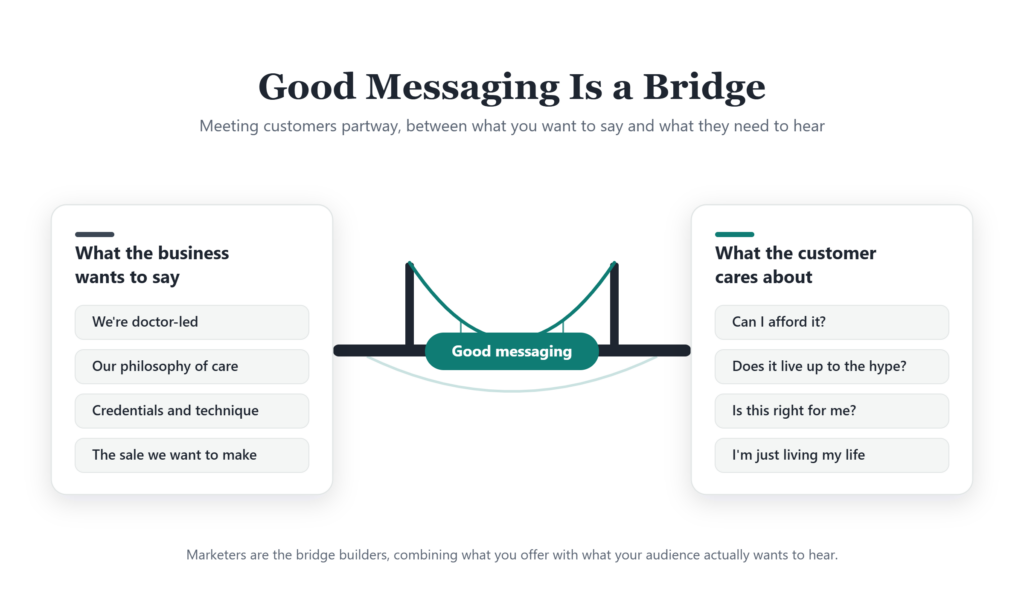
Underneath the overcomplicated offer sits a deeper problem: what matters to the business owner is often not what matters to the customer, and owners forget that. Brandon sees it constantly in healthcare marketing. An orthodontist might build their messaging around being “doctor-led” and a particular philosophy of care. But ask actual patients how they feel about that and many are surprised it is even a selling point, since they assumed a doctor was in charge. Their real concerns are simpler: can I afford Invisalign, and does it live up to the hype?
That gap is why he describes good messaging as a bridge. On one side sit the business owner’s concerns and the things they want to talk about. On the other are customers living their lives, who are not thinking about the mechanics of insurance or orthodontics or the medical codes for braces. Good messaging meets them partway, pulling the audience a little toward you while you move toward them. As Brandon puts it, marketers are the bridge builders, and the strongest work happens when you build that bridge together with the client, combining what they offer with what the public actually cares about.
Don’t Market From the Basement
Brandon connects buyer behavior to Maslow’s hierarchy of needs. Underneath most decisions sit two big drivers: am I loved, and am I safe? Safety and security, acceptance and belonging, shape a huge share of what people do, with wants and desires stacked on top.
The common mistake, especially in a narrow niche, is staying “in the basement,” where every message is about safety and avoiding loss: do not lose money, do not take a risk. That has its place, but it leaves value on the table. Sometimes the stronger motivator is a higher need, like acceptance or a sense of purpose. He notes the hierarchy is not as rigid as the classic pyramid suggests, since in real life people move back and forth between these needs. The point for marketers is to not get stuck speaking only to the most basic ones.
Throw the Rope Anyway
Brandon closed with the idea that stuck with us most. Beyond his companies, he serves on the board of the local chapter of the American Marketing Association and runs its monthly coffee clubs, an informal first-Thursday gathering where marketers meet, network, and occasionally vent about the client who still has not paid for three months of work.
He noticed many people show up to networking with a mercenary mindset: I need a job, I need clients, I need to hire. Those outcomes do happen at good events. But he offers a different metaphor. When he started Words Have Impact, mentors took him under their wing, answered his questions, and made introductions, and a few even became clients. At the time he pictured himself in the quicksand while they stood on stable ground throwing him a rope. He later realized that framing was wrong. Everyone in marketing is in the quicksand in some way, all hustling, all trying to grow. Those mentors were not more stable or more successful. They threw the rope anyway. And if everyone throws the rope, the ropes weave into a net that lifts all of us.
That is the spirit he wants for the St. Louis marketing community. With enough talent and enough grit, he believes the region can rival the coasts, offering capable, down-to-earth partners without the overhead of a New York or LA office. For Brandon, it comes back to people. Words have impact because they land on people’s lives, and the job is to keep throwing the rope. If you see a chance to help or elevate someone, take it. It tends to come back tenfold.
Ready to Put Buyer Psychology to Work?
Brandon Towl’s approach is a reminder that the best marketing starts with how people actually think and decide. Make the purchase effortless, make the brand something people feel, match your message to how the decision really gets made, and build a bridge between what you offer and what your customer cares about. If you want a partner who thinks that way about your marketing, let’s talk.
Never Miss an Episode
Get more conversations on marketing, strategy, and the psychology behind how people buy. Subscribe to the Intergetik podcast and follow along. Subscribe and Listen
Want to Be Featured?
We love connecting with marketers, founders, and industry pros. If you would like to share your story or expertise on the Intergetik podcast, we would love to hear from you.
Get in Touch